> For the complete documentation index, see [llms.txt](https://docs.zigpoll.com/llms.txt). Markdown versions of documentation pages are available by appending `.md` to page URLs; this page is available as [Markdown](https://docs.zigpoll.com/email-zigpoll-surveys.md).
# Email Zigpoll Surveys
## **📩 How Email Surveys Work in Zigpoll**
Zigpoll allows you to send surveys directly via email, either manually or automatically through Shopify events. This guide explains how email survey sending works behind the scenes, how to set up sender and survey domains, and how Zigpoll identifies respondents.
If you want to deliver Zigpoll surveys via your own email platform (ex. Klaviyo), read our Integrations page to see if your platform is supported
{% content-ref url="/pages/-MkcAljZVNlkwKq4JoDM" %}
[Integrations](/integrations.md)
{% endcontent-ref %}
***
### **1. Ways to Send Email Surveys**
#### **1.1 Manual Email Sends**
Manual sends allow you to deliver a survey to a specific list of recipients.
**How it works:**
* You select recipients directly inside Zigpoll.
* Zigpoll sends the survey using either the default sender domain or your custom sender domain (if configured).
* The recipient’s email address is encoded in the survey link.
* When they submit the survey, Zigpoll automatically associates the response with that email.
**Use cases:**
* One-off feedback campaigns
* Follow-ups to segmented customer lists
* Pre-launch customer research
**How to send:**
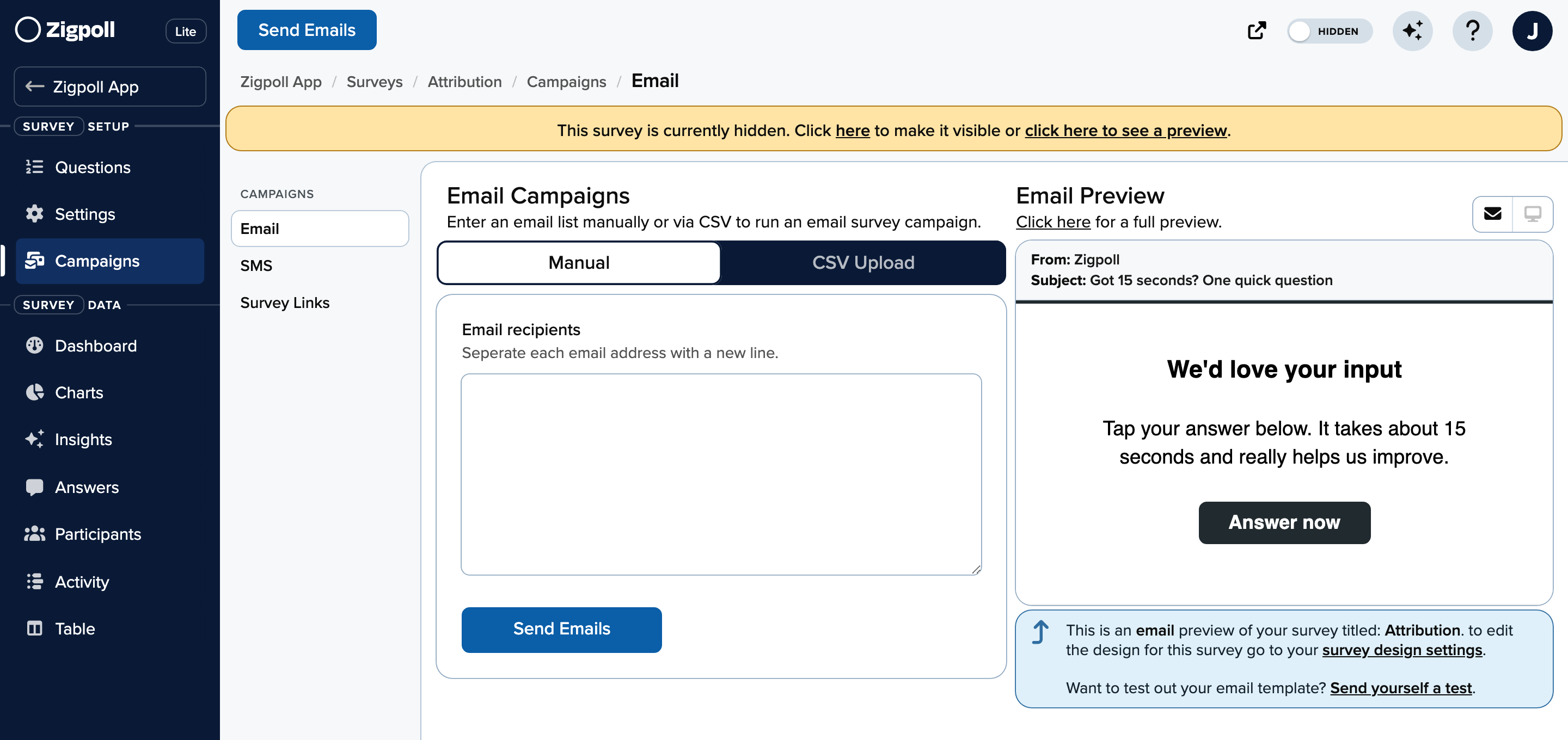
1. Open the survey and go to **Campaigns → Email**.
2. Pick how you want to add recipients:
* **Manual**: type or paste email addresses.
* **Auto Segment** (Shopify stores only): build a segment from your Shopify customers.
* **CSV Upload**: upload a CSV of recipients. See [CSV formatting](/tutorials/csv-formatting.md).
3. Click **Send Emails** and confirm.
The survey must be visible before you can send. SMS works the same way under **Campaigns → SMS**.
**Can I schedule a send for a later date?**
No. A campaign goes out as soon as you click **Send Emails** or **Send SMS**. There is no send date to set. For surveys sent by a Shopify trigger, you can use the **Activation Schedule** in **Settings → General → Details** to switch the survey on at a set time.
**Sending to a whole segment or customer list**
* On Shopify, use **Auto Segment** and set the customer rules you want. Zigpoll shows how many customers match before it sends. See [Email a Shopify customer segment](/tutorials/email-shopify-customer-segment.md).
* On any platform, export your list from your store or email tool and send it with **CSV Upload**.
Every campaign counts against your plan's monthly email allowance (or SMS allowance for SMS). If a send is bigger than what is left for the month, Zigpoll blocks it and tells you how many you can still send, for example "You can only send 120 more emails on this plan." See **Email Volume & Plan Limits** below.
***
#### **1.2 Automated Sends from Shopify Orders**
Zigpoll can automatically trigger email surveys when certain Shopify events occur.
**Supported triggers:**
* **Abandoned checkout**
* **Order Created**
* **Order Paid**
* **Order Cancelled**
* **Order Fulfilled**
* **Order Delivered**
* *Note:* “Order delivered” requires carriers recognized by Shopify (USPS, UPS, FedEx, DHL, etc.).\
Third-party or unsupported carriers may not fire delivery events.
**How to set up an automated send:**
1. Open the survey and go to **Settings → Delivery → Format**. Choose **Email** (or **SMS**).
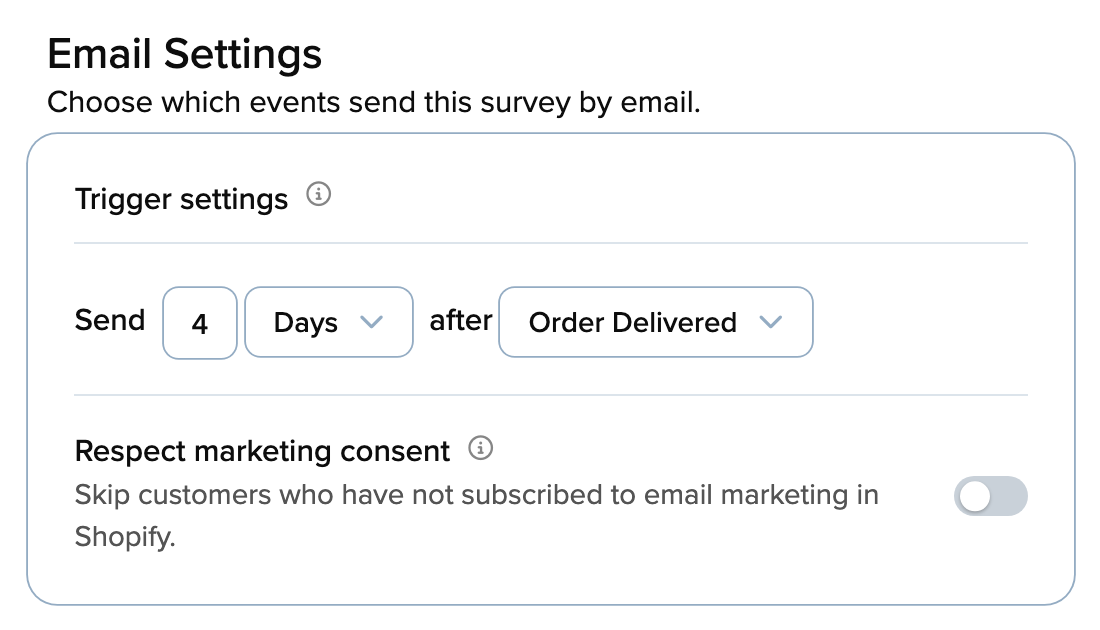
2. In the **Email Settings** card, pick the event under **Trigger Settings** (e.g., *Order Delivered*) and how many minutes, hours, or days to wait. Click **Save Changes**.
From then on, when Shopify reports the event, Zigpoll waits out the delay and sends the survey email. Shopify passes along the customer and order details, so Zigpoll knows who is responding.
This method is fully automated and ideal for post-purchase feedback loops.
{% hint style="warning" %}
**Triggers are not retroactive.** Zigpoll starts listening for Shopify events when you save the trigger. Only events that happen after that, while the survey is visible, send an email. Orders that were already paid, fulfilled, or delivered before you set up the survey are not emailed, and events that happen while the survey is hidden are skipped rather than queued. To reach past customers, export them from Shopify and send them a manual campaign (see **2.1 Manual Email Sends** above).
{% endhint %}
**Stopping automated sends**
Switching the survey's delivery format to **Link** removes its Shopify order trigger, so new orders no longer schedule emails. Hiding the survey does the same. Emails already scheduled and waiting out their delay can still go out. Check the survey's **Activity** page to confirm nothing new is being sent.
**Respect marketing consent**
In the **Email Settings** card under **Settings → Delivery → Format**, you can turn on **Respect marketing consent**. When enabled, Zigpoll checks the customer's marketing status in Shopify at the moment each message is sent and only delivers to customers whose status is **Subscribed** — email marketing consent for email surveys, SMS marketing consent for SMS surveys. Customers who are pending, unsubscribed, or who never opted in are skipped, as are customers who unsubscribe during the send delay. This works for every trigger above, including abandoned checkout.
***
### **2. Designing Your Survey Email**
You can customize the survey email template directly inside Zigpoll.
#### **2.1 Accessing the Email Editor**
1. Open your Zigpoll survey.
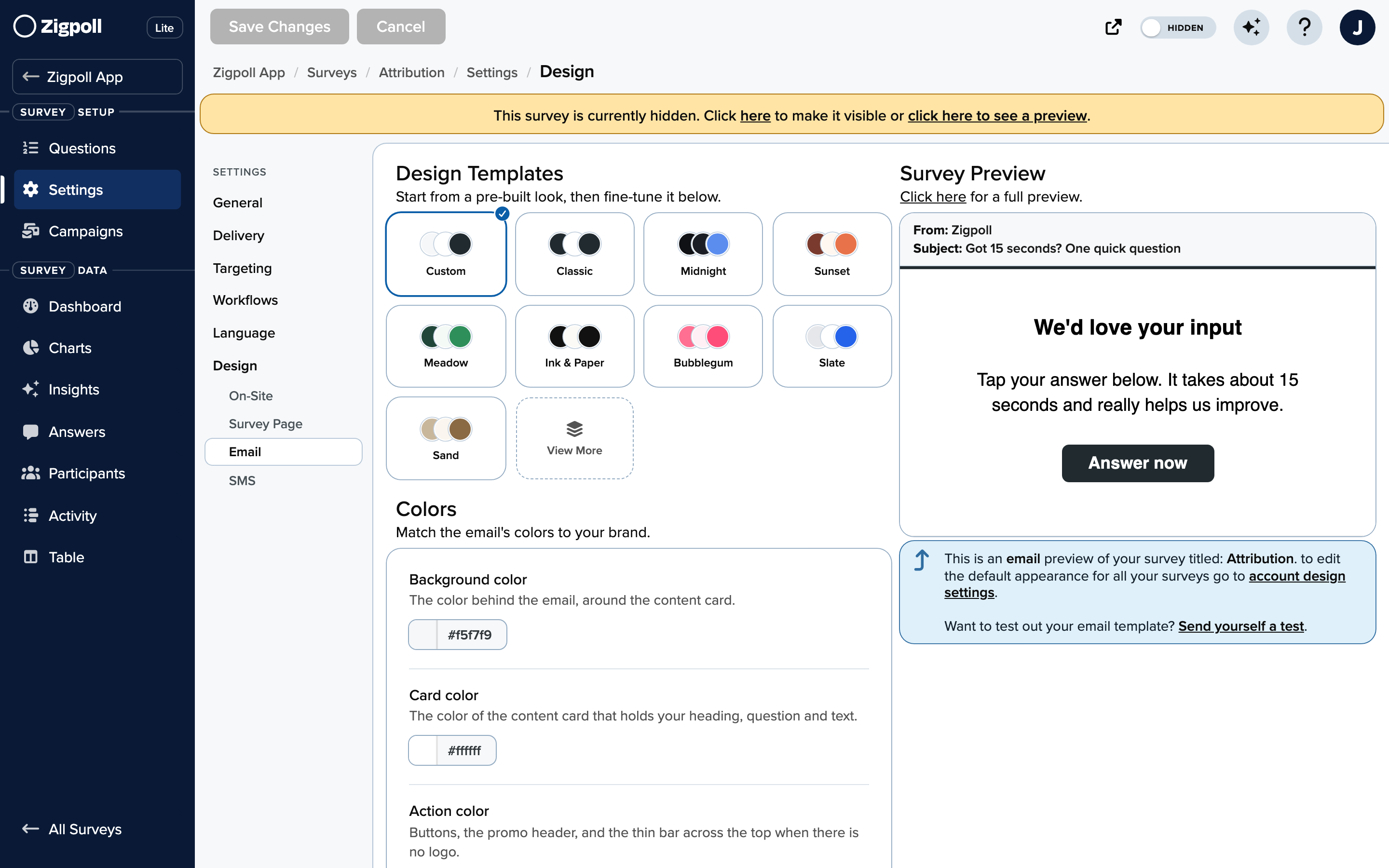
2. Go to **Settings → Design → Email**. The SMS message is under **Settings → Design → SMS**.
3. The editor displays your default template (based on the survey style you selected).
To set the email design for every survey on the account, use **Settings → Design Defaults → Email** at the account level.
#### **2.2 Customization Options**
You can customize:
* Subject line
* Body copy
* CTA button text
* Logo and branding
* Layout and color scheme
These changes apply immediately to both manual and automated sends.
#### **2.3 Sending in Your Customer's Language**
Every part of the email — subject, header, body, button, and footer — and the SMS message can be translated per language. Zigpoll automatically sends the matching language whenever it knows the customer's locale (from Shopify, a CSV `locale` column, and more). Add translations under **Settings → Language**:
{% content-ref url="/pages/-LrVMaacbU4WTFf6p6i5" %}
[Language and Translations](/polls/language-settings.md)
{% endcontent-ref %}
***
### **3. Sender Name, Address, and Custom Sender Domains**
#### **Where the sender name comes from**
The name customers see is the **Sender** field in the **Sender** card under **Settings → Design → Email** (or **Settings → Design Defaults → Email** for the whole account).
* If the field is blank, emails are sent as **Zigpoll**.
* When you install Zigpoll from Shopify, the field starts as your store's `.myshopify.com` handle, for example `my-store-123`. That is why some emails show a store id as the sender. Replace it with your brand name and click **Save Changes**.
The same card has **Reply To** (where customer replies go) and **CC Recipients**.
#### **Why emails come from **
Without a custom sender domain, every survey email is sent from `noreply@zigpoll.com`, with your sender name in front of it. Once a custom sender domain is verified, the address becomes `noreply@` your own domain. If your **Reply To** address is on that same domain, Zigpoll sends from the Reply To address instead.
Custom sender domains are available on the **Standard plan and higher**.
#### **3.1 What a Custom Sender Domain Does**
A custom sender domain lets you send surveys from an address on your own domain, such as `noreply@yourstore.com`, for a fully on-brand, white-labeled experience. This improves:
* Brand trust and recognition
* Email deliverability
* Open and engagement rates
#### **3.2 How to Set It Up**
1. In your Zigpoll dashboard, go to **Settings → Custom Domains** and enable **Custom Sender Domain**.
2. Enter a dedicated sending subdomain (e.g. `mg.yourstore.com`). Zigpoll generates the SPF and DKIM DNS records.
3. Add the records via Auto-Connect DNS or manually.
4. Click **Verify Domain**. The domain activates automatically once the records validate.
Full step-by-step setup and troubleshooting:
{% content-ref url="/pages/JgEtyJSLugjf6u3mmYxI" %}
[Custom Sender Domains](/faq/custom-sender-domains.md)
{% endcontent-ref %}
***
### **4. Custom Survey Domains**
A custom survey domain changes the URL where customers complete your survey — from `survey.zigpoll.com/your-survey` to something like `survey.yourstore.com/your-survey`. Paired with a custom sender domain, this gives you a fully white-labeled email survey experience.
Setup, SSL, and troubleshooting are covered on their own page:
{% content-ref url="/pages/Y4KWlFoXIXAwYXbQXf4z" %}
[Custom Survey Domains](/custom-survey-domains.md)
{% endcontent-ref %}
***
### **5. Deliverability and Spam**
If survey emails land in spam or are not arriving:
* **Set up a custom sender domain.** Mail from your own verified domain is trusted more than mail from a shared address.
* **Change the sender name** from the default or store handle to a name customers recognize.
* **Rewrite the subject line and copy** so they read like a message from your brand, not a generic request.
* **Check the Activity page.** Open the survey and go to **Activity** to see which emails were sent and to whom.
* **Suppressed addresses are skipped.** Zigpoll does not send to an address that hard-bounced or marked a Zigpoll email as spam, or that unsubscribed from your emails. These skips are expected and protect your sender reputation.
***
### **6. "Manual approval is pending"**
To protect deliverability for every merchant, Zigpoll screens new accounts for spam and phishing. If a check flags your account, you see this message when you try to send:
> Manual approval is pending. If approved you will be able to do this within 24 hours.
**What triggers a review.** Accounts that support has already approved are never flagged. For other accounts, a review starts when:
* A survey, email design, or SMS message is flagged by the automated spam and phishing check. The check runs when you create a survey, save a question, make a survey visible, save the email or SMS design, or save email and SMS translations.
* The email button color is the same as the button text color.
* An account on a trial sends a campaign or a Shopify customer segment.
* A one-question survey is sent to more than 100 recipients at once.
* A new account with little survey activity sends to more than 500 recipients at once.
**What happens while it is pending.** Email and SMS campaigns, test SMS messages, and automated emails from Workflows are paused. If survey content was flagged, the survey is hidden and cannot be made visible until the review is done.
**How long it takes.** The Zigpoll team reviews flagged accounts by hand. If the account is approved, you can send within 24 hours. If you have been waiting longer, or think the flag is a mistake, email with your account name.
***
### **7. How Zigpoll Identifies Respondents**
Zigpoll automatically associates responses with the correct customer. Here’s how identification works in each sending mode.
#### **7.1 Surveys Sent by a Shopify Order Trigger**
When a survey is sent because of a Shopify event:
* Shopify sends Zigpoll the customer and order details along with the event.
* Zigpoll attaches those details to the respondent automatically.
* No email field or identification step is needed in the survey itself.
#### **7.2 Manual Sends**
For manual campaigns:
* Zigpoll encodes the recipient’s email in the survey link.
* When the respondent completes the survey, Zigpoll links it back to that email automatically.
No additional setup is required.
***
### **8. Email Volume & Plan Limits**
All Zigpoll plans include a monthly email send allowance.
* Every email actually delivered counts toward your quota.
* Webhook-triggered and manual sends are treated the same. [Nudge reminders](/polls/nudge-non-responders.md) also count toward the same quota.
* SMS has its own separate monthly allowance.
* When the allowance runs out, campaigns are blocked and automated emails stop until the month resets. They are not queued for later.
* You can view your current usage under **Settings → Plans & Limits**.
{% hint style="info" %}
On the free **Lite** plan, email campaigns are available for Shopify-connected accounts. Non-Shopify accounts need a **Standard** plan or better to send campaigns.
{% endhint %}
See our plans for more details:
{% content-ref url="/pages/-LZzntn1HSzaiXwIaBqe" %}
[Subscription Plans](/subscription-plans.md)
{% endcontent-ref %}
---
# Agent Instructions
This documentation is published with GitBook. GitBook is the documentation platform designed so that both humans and AI agents can read, navigate, and reason over technical content effectively. Learn more at gitbook.com.
## Querying This Documentation
If you need additional information that is not directly available in this page, you can query the documentation dynamically by asking a question.
Perform an HTTP GET request on the following URL with the `ask` and `goal` query parameters:
```
GET https://docs.zigpoll.com/email-zigpoll-surveys.md?ask=&goal=
```
`ask` is the immediate question: it should be specific, self-contained, and written in natural language.
`goal` is what the user is ultimately trying to achieve, the reason they need the answer. Sharing it helps GitBook give you a better, more relevant answer. A goal is most helpful when it describes the outcome the user wants rather than restating the question. For example, with `ask=how do I create an API token`, a goal like `build a script that syncs our docs to a CMS` lets GitBook tailor the answer to that use case.
The response will contain a direct answer to the question and relevant excerpts and sources from the documentation.
Use this mechanism when the answer is not explicitly present in the current page, you need clarification or additional context, or you want to retrieve related documentation sections.