> For the complete documentation index, see [llms.txt](https://docs.zigpoll.com/llms.txt). Markdown versions of documentation pages are available by appending `.md` to page URLs; this page is available as [Markdown](https://docs.zigpoll.com/polls/top-4-surveys-to-start-with.md).
# Top 4 Surveys to Start With
Make the most of the platform by starting with these surveys
After reviewing how some of the fastest-growing ecommerce brands use our surveys, here are four easy-to-implement surveys. These are survey questions that are easy to install, fast to collect data, and designed to provide immediate business value.
To see what came back when brands ran these surveys, and what they did with the answers, read [What Brands Have Learned with Zigpoll](/guides/what-brands-have-learned.md).
***
#### 1. Post-Purchase Attribution ("How did you hear about us?")
Traditional attribution is failing marketing agencies and brands because platforms like GA4 struggle to track view-through conversions and often incorrectly label sales as "direct".
* The Goal: Uncover the true drivers of your sales, including "hidden" channels like influencers, podcasts, or word-of-mouth (WoM).
* Why it works: It captures the customer’s actual journey.
***
#### 2. Conversion Diagnostics ("What almost stopped you from purchasing?")
Don't guess why your site isn't converting. Ask the visitors who just navigated it. This is your most powerful tool for Conversion Rate Optimization (CRO).
Ask this question in post-purchase or in exit-intent popups.
* The Goal: Identify "conversion killers" such as bugs, pricing confusion, or missing information.
* Why it works: You can run this as a post-purchase question or as an exit-intent survey for visitors about to bounce.
**One brand discovered that customers almost didn't purchase due to missing colorways. Launching those colorways led to a 6-figure product line.**
***
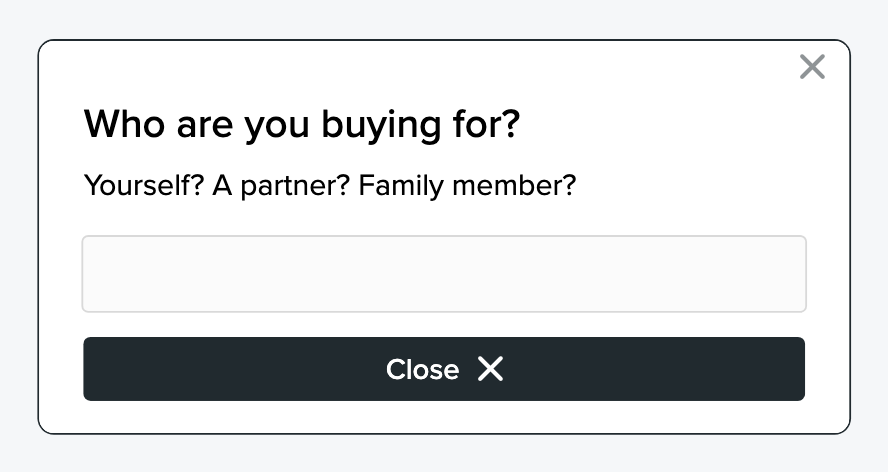
#### 3. Gift Tracking and Segmentation ("Who are you buying for?")
Gift buying is consistently higher than you think!
* The Goal: Asking this question in post-purchase helps with determining what % of your customers are gift-purchasers, when gift buying starts to increase, and who the gift recipient is.
* Why it works: Knowing if a customer is buying for themselves vs. as a gift changes everything.
**One brand discovered that 30% of their purchasers were women buying gifts for partners**, leading them to completely overhaul their ad creative.
***
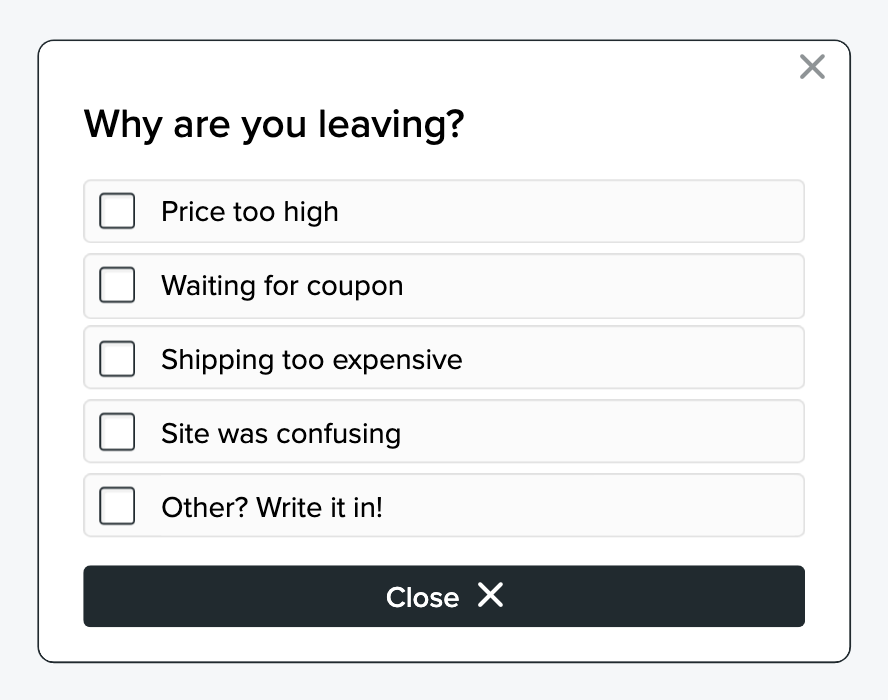
#### 4. Abandoned Cart Diagnostics ("Why are you leaving?")
When a visitor adds items to their cart but doesn't check out, you have a unique opportunity to capture their feedback at the moment of highest intent.
* The Goal: Understand the specific blockers at checkout, such as shipping costs, payment issues, or simply waiting for a discount.
* Why it works: You can trigger exit-intent surveys specifically for cart-leavers.
**One brand realized that over 50% of abandoned carts were from customers just testing to see if they could trigger a coupon code.** More exit intent findings are in [What Brands Have Learned with Zigpoll](/guides/what-brands-have-learned.md#exit-intent-what-makes-visitors-hesitate).
---
# Agent Instructions
This documentation is published with GitBook. GitBook is the documentation platform designed so that both humans and AI agents can read, navigate, and reason over technical content effectively. Learn more at gitbook.com.
## Querying This Documentation
If you need additional information that is not directly available in this page, you can query the documentation by asking a question.
Perform an HTTP GET request on the following URL with the `ask` and `goal` query parameters:
```
GET https://docs.zigpoll.com/polls/top-4-surveys-to-start-with.md?ask=&goal=
```
`ask` is the immediate question: it should be specific, self-contained, and written in natural language.
`goal` is what the user is ultimately trying to achieve, the reason they need the answer. Sharing it helps GitBook give you a better, more relevant answer. A goal is most helpful when it describes the outcome the user wants rather than restating the question. For example, with `ask=how do I create an API token`, a goal like `automate deployments from our CI pipeline` lets GitBook tailor the answer to that use case.
The response will contain a direct answer to the question and relevant excerpts and sources from the documentation.
Use this mechanism when the answer is not explicitly present in the current page, you need clarification or additional context, or you want to retrieve related documentation sections.